At some point in my cycling career, I discovered Spokane Bicycle Club. That was before the Internet amounted to much, so I might have seen it in the paper, or maybe someone told me about. (BTW, today I learned on the Internet that the club had been reincarnated just a short time before I discovered it. Serendipity?)
SBC fit my interests like a glove. It wasn’t a racing club, where I wouldn’t have been competitive. It wasn’t a picnic-basket sort of group either. It was a bunch of ordinary mortals — most of them over 40 — who enjoyed serious cycling.
Spokane is a great place to cycle year round. Oh, there’s a little snow at times, but you’d be surprised how well a mountain bike works in that stuff. I commuted eight miles to work on my bike year-round for six years without much trouble.
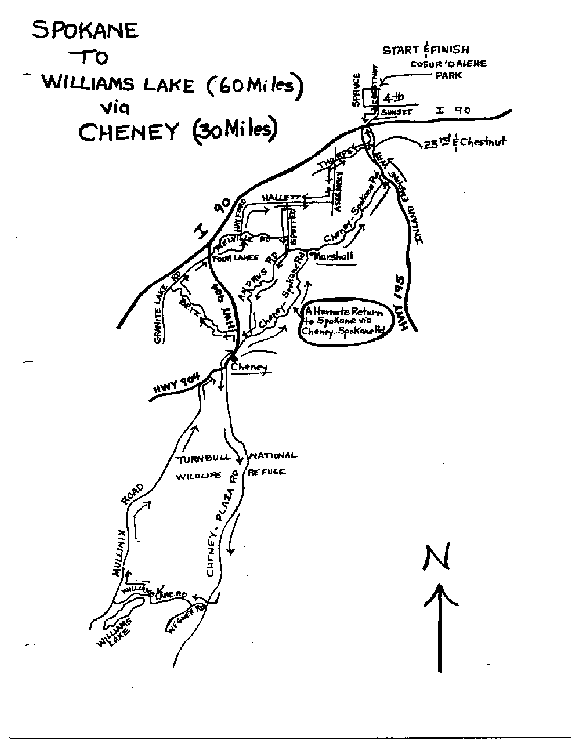
An early map for a typical SBC ride.
The roads are the best thing about Spokane cycling. Native Americans established routes to the nice places in Washington long before white men arrived. Naturally, they followed creeks and the contour of the land. Those are the easiest ways to get to where they were going.
Roads in the plains states follow the rigid grid imposed by the hasty government survey instigated under the abominable concept of manifest destiny. Don’t get me started… The survey didn’t reach Washington Territory though.
That’s why roads around Spokane follow natural routes. The interlopers just turned the trails into roads. They are much more pleasant to travel on than the grid in Flyover Territory. The result was that cycling routes in Washington are much like those in Europe (or Canada and Alaska).
SBC offers a wide variety of rides. I started with some of their shorter ones, but soon gravitated to Saturday rides, which were more ambitious. The general scheme for a Saturday was to cycle out to a small town for breakfast, take a scenic route back, and cover 50 to 80 miles.
Sometimes we more or less paralleled the Centennial Trail from downtown Spokane over to Coeur d’Alene or beyond. (You’re supposed to get a permit for a group on the trail, so we only used bits of it as necessary). We often stopped in Post Falls along the way for breakfast at a place that served wonderful buckwheat pancakes.
The “Valley Chapel” ride was one of my favorites. It starts at the South Hill region of Spokane, drops down to Latah Creek, climbs back up to the town Rockford, and returns on the Palouse Highway. Latah Creek flows along in a mile-wide gully, essentially a canyon and the ride there is idyllically rustic. There is a two-mile climb up to Rockford, which most riders complain about. That was the best part of the ride for me. A short burst of effort and you were up out of the canyon and on your way downhill to Rockford.
I usually picked “Devils Gap” loop when it was my turn to plan a ride. For some reason, I was the only one who chose that route, but everyone was excited about it when I did. The ride starts downtown by the river, climbs the grade up past the Air Force base, and proceeds out on Highway 2 to Reardon for breakfast. Then it heads north toward Long Lake on the Spokane River and turns back toward Spokane at Devils Gap (two prominent bluffs). There are three miles of fantastic coasting down to the gap.
The road climbs back out of the Spokane River Valley after ten miles or so and then descends back to the Nine Mile Falls region below Spokane. Another thrilling descent. From there it follows/parallels the Centennial Trail to where we started.
Most of us went to Libby, Montana for the “Scenic Tour of the Kootenai River” a few times in the 1990s. STOKR is a “Century” (a 100-mile ride). It follows the river down past Kootenai Falls, ascends the valley of Yaak Creek, goes over a high mountain ridge and returns to Libby. There are about 50 miles of constant climb to the summit. Then there are five miles of the most exciting descent I’ve ever experienced.
The descent is paved, but it is steep, twisting, narrow and lumpy. There is no traffic so you can go as fast as you dare (35-40 mph) for about five miles. After that there are 20 more miles of downhill where you scarcely need to pedal to keep up 20 mph. It takes half a day to get to the top and an hour or so to get back.
SBC puts on the Autumn Century each year. The officers planned those events, and I was the treasurer for a few years. We knew there was a lot of broken glass on the route we preferred one year. I suggested we ride the route and sweep the glass off the shoulder. Off we went with our dust brooms the week before the scheduled ride. It was a splendid day and we had a great time. We touted the ride’s “hand-swept route” on our flyers.
It takes seven or eight hours for most riders to complete a century. There are three or four stops along the way where you can get food and water. On one century I “rode to the ride,” which added 20 miles at each end of the 100 miles. But I was already wondering how much further I could go by the time I got to Loon Lake. No doubt because I hadn’t been eating enough along the way. I had ridden 95 miles and it was another 45 miles back home.
I decided to rest a while at the food stop at Loon Lake and discovered they had a basket of boiled red potatoes. I ate a bunch of them sprinkled with salt and began to feel a lot better. So I headed for Spokane. I actually felt better and better as I went along. That starch fueled my effort evenly as I rode along. I had been thinking I’d be forced to stop at the official end of the ride and have Marcia come and get me. As it turned out I made it all the way home with no trouble.
By rough calculation, I rode over 20,000 miles with SBC in 10 years. It was simply grand out there on the road with my friends. It’s hard to relate exactly how it feels to know you’re all able to doing something hard and enjoying it. A few times I’d feel worn out at the 50- to 70-mile point in a ride, but knew there were only 20 miles or so to go. You can always do another 20 miles. 😉
After 60 years, I’m relearning Morse Code to get back into amateur radio. Walking down by the river yesterday, I was thinking about how essential mail-ordered radio parts were for me back in the day. There just weren’t any radio-parts stores out in the middle of Kansas. The only one I ever saw was on a high-school trip to Kansas City. I eagerly walked a mile from downtown only to find it closed (not unusual on Saturdays then).
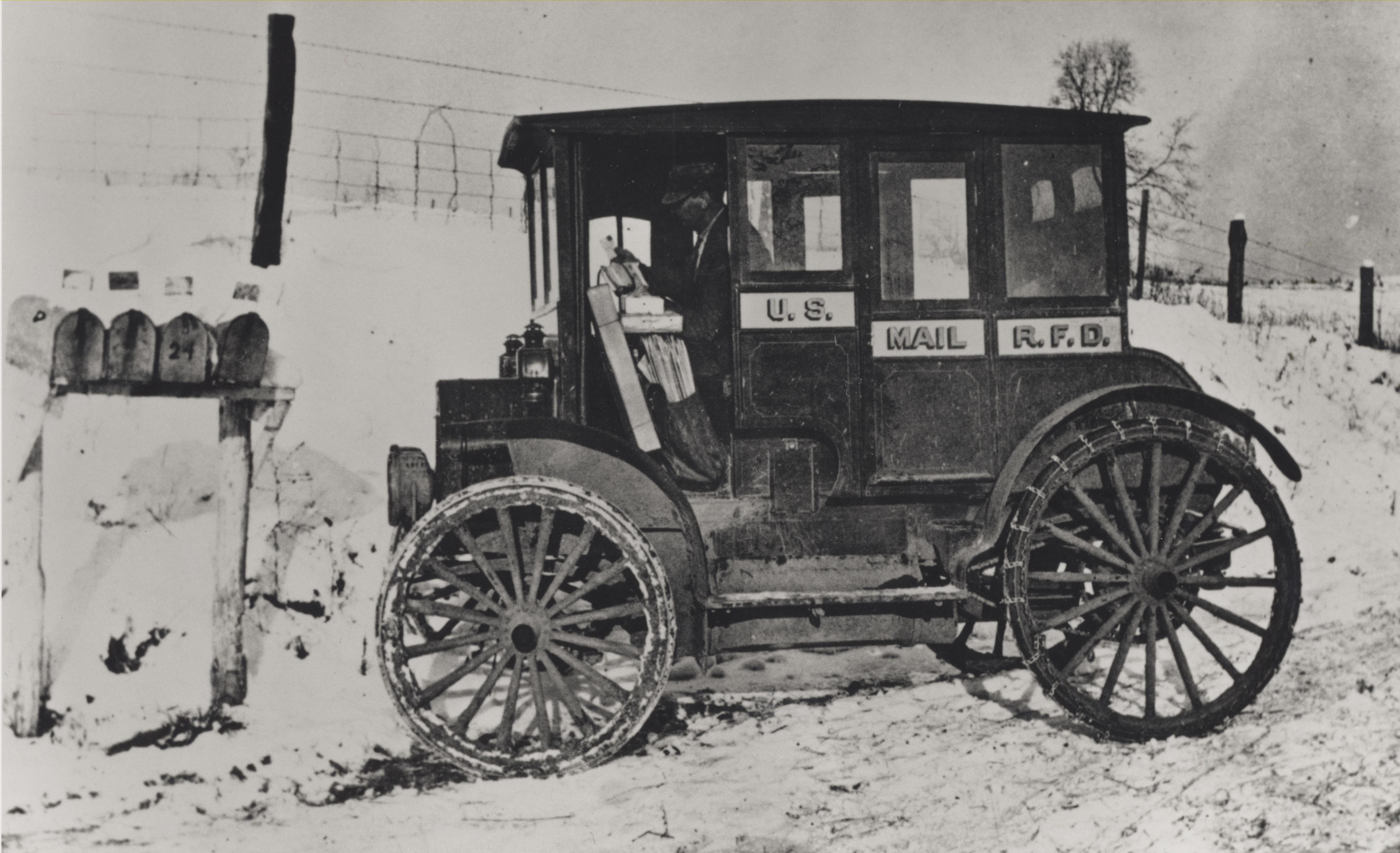
But thanks to Rural Free Delivery, everything I wanted was available by mail order. As I was walking along, it occurred to me that Rural Free Delivery was the 19th Century precursor of Internet commerce. And Sears Roebuck was the Amazon of the day.
There still aren’t any amateur-radio stores in most cities, for example in Spokane. Even the fairly useful Radio Shack (once mail-order only) stores are gone. All that changed in 60 years is the Internet and FedEx replaced the mail order system.
Click to see the whole strip.
Now here’s a bit of weirdness: Today, I stumbled across an article, where else but the Internet? that paralleled my thoughts. It’s all about how Amazon is emulating (perhaps unconsciously) Sears Roebuck, the once King of Retail. The best part of that is that the wait for your order to arrive has shrunk from a week or more down to two days.
The article describes how Jeff Bezos’ strategy parallels the original Sears strategy. Amazon is disrupting retail sales again to become King of the Hill. I could say the coincidence of that article shows that great minds flow in the same channel, but that would be immodest.
Marcia and I went camping at Jim Creek — a Navy recreation facility — with Susan (Clark) Johnson, her mother Jane (Marcia’s sister), Dan Johnson, and “the girls” circa 2010. The topic of brain injury in high school football came up. That led to my regaling them with stories of my high school football “career.” It was suggested, and I agreed, that I should blog about that here at Didit.Live. What they really wanted me to do though, was for me to post my Las Vegas story, which I had related earlier.
So here goes…
*******
It was 1953: The Korean War was on. I was working hard to keep my grades up so the draft board would let me stay in college. Everyone needs diversion though, and that was especially true in those days. One of my beer-drinking buddies came up with a colossal one.
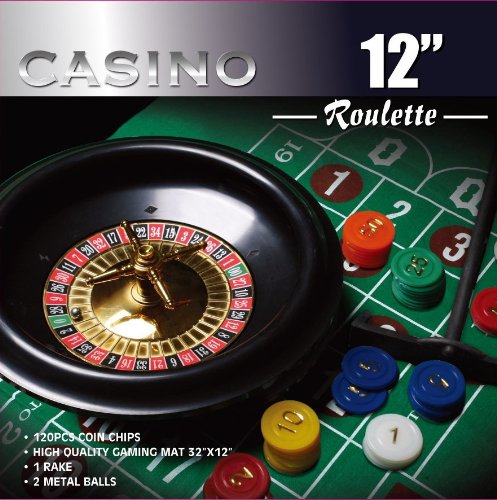
He had stumbled across a little book that described a “sure-fire” way to win at Roulette. The logic was convincing. Simply write 1 – 2 – 3 on a slip of paper. Add the outside numbers (1+3 = 4) and bet 4 dimes (the minimum bet was 25 cents in Las Vegas then). If you lose, write 4 at the end of the string. You now have 1 – 2 – 3 – 4 on your slip of paper, so you must bet 1 + 4 = 5 dimes. If you win, cross off the 1 and 5 and you are left with 2 – 3. Your bet now is 5 dimes. Continue with this rule until you cross off all the numbers in your string. You end up
A complete example (using dollars)
Start with 1 – 2 – 3 on your tally sheet
Bet $4 (1+3), lose: Add a 4 to the end, giving 1 – 2 – 3 – 4
Bet $5 (1+4), lose: Add a 5 to the end, giving 1 – 2 – 3 – 4 – 5
Bet $6 (1+5), win: Remove the 1 and 5, leaving 2 – 3 – 4
Bet $6 (2+4), lose: Add a 6 to the end, giving 2 – 3 – 4 – 6
Bet $8 (2+6), lose: Add an 8 to the end, giving 2 – 3 – 4 – 6 – 8
Bet $10 (2+8), win: Remove the 2 and 8, leaving 3 – 4 – 6
Bet $9 (3+6), win: Remove the 3 and 6, leaving 4
Bet $4,(4+0), lose: Add a 4 to the end, giving 4 – 4
Bet $8 (4+4), win: Remove the 4 and 4, which closes the string.
You started with a $4 bet and ended up $8. Double your money — guaranteed! (Supposedly.)
Actual Roulette odds are 47.37% for the player. That’s more generous than in this example, which was only 4 wins out of 9 = 44.44%. Other examples might be 6 wins out of 15 = 40%, 7 out of 20 = 35% and 11 out of 30 = 37%. These examples are not as lucky, but they show you don’t need anything as good as player odds (47.37%) to close those double-your-money strings.
We weren’t sure things were that simple though. So we bought a toy Roulette wheel to test the system. Using it gave us a feel for the timing of the game as well as the actual sequences of wins/losses we needed to judge the outcome. After many hours of testing, we calculated we could each be winning $52 an hour ($5 an hour was big money in those days). Our major concern was what we would do if it worked out. Would we be tempted to stay in Nevada instead of returning to graduate?
All we needed now was a bankroll. We figured $300 (more like $6,000 today) would do it. How were four college kids going to come up with that kind of money? We were only planning a quick test of the system, so it didn’t all need to be our money.
We decided to offer shares in the trial to our fellow students. We offered two tiers: Double your money if we win, half back if we lose; or triple your money if we win, and a third back if we lose. The psychology worked and we soon had the $300.
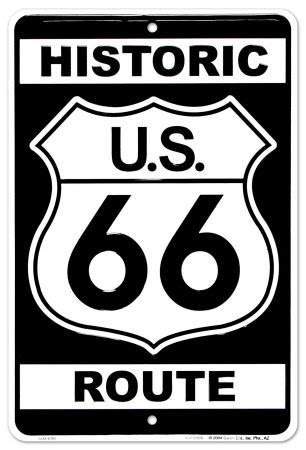
Gene Bechtel, Joe Kennedy, Manly Draper and I started out for Las Vegas when the Thanksgiving break started. I had a nice 1948 Ford coupe, and we planned to drive it non-stop because we had just a few days until classes started again. Off we went, headed for Route 66, as soon as the last class session was over.
I went to sleep while someone else took the wheel sometime after it got dark. Around midnight, they woke me up. What the heck? They told me it was snowing and a according to the radio a blizzard is on its way. “What are we going to do?” they asked.
We were west of Amarillo, Texas at that point. You do not want to be caught in a blizzard there on the front side of the Rockies. I told them we should head for Amarillo because we could stay ahead of the storm by going east. We might have to stop in Amarillo but we’d be safe. By the time we got there, the snow was thinning out. We decided to go on to Oklahoma City because one of our buddies was in medical school there.
We surprised Lud (Ludwig?) the next morning, spent the day visiting, talked about med school, and then went to a “secret” roadhouse that night (we were in a “dry” county). The beer and food were good, and the music was loud and animated. That’s about all I remember. The next day we were back in McPherson, licking our wounds.
We decided to try again during Christmas break. We made up a cock and bull story about why we wouldn’t be home and off we went again. For reasons I forget, we decided to drive a worn-out 1940 Chevrolet this time. Weather forecasting was pretty rudimentary in those days, but we missed any storms that might have come along. Our trip took about 24 hours non-stop.
Route 66 was a two-lane highway. The scenery along it was grand but a little monotonous. Small towns along the way were something you looked forward to and marked your progress by. We kept an eye out for Whiting Brothers gas stations too. We worried a little about the “cheap” gas there, but the old Chevy seemed to run fine on it.
Somewhere between Albuquerque and Gallup, we had a startling experience. It was in the middle of the night and pitch black. A pair of headlights ahead on a vehicle ahead tilted sharply and it was suddenly coming straight at us in our lane. A moment later its headlights tilted the other way and it swerved back to its lane. We had slowed down by then, and a Greyhound bus flew by. Up the road, we spotted a donkey standing in the middle of the road. It was all happened so quickly we weren’t shook-up until we thought about it for a minute.
The rest of our drive through the arid landscape was without incident. We were getting hungry by the time we neared Flagstaff when spotted a Smorgasbord at the side of the road. It was the finest spread we’d ever seen. The price was $5 thoughs. That was way too high in our opinion (would be like $50 today). I imagine we had something to eat in Flagstaff.
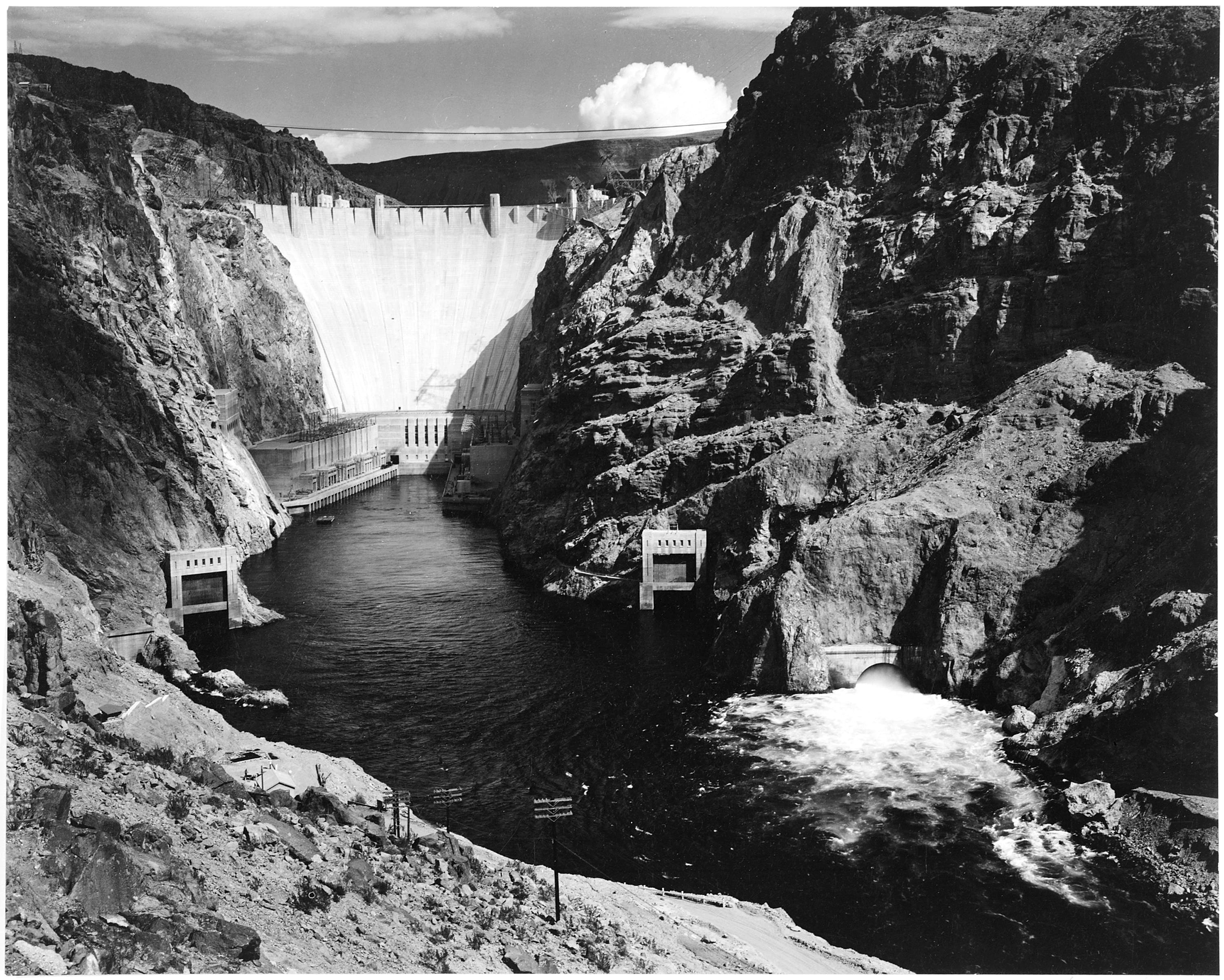
We got off Route 66 at Kingman in the early afternoon and headed for Las Vegas. We were eager to see Bolder [now Hoover] Dam and it did not disappoint. We were even more eager to get to Las Vegas though, so we soon pressed on.
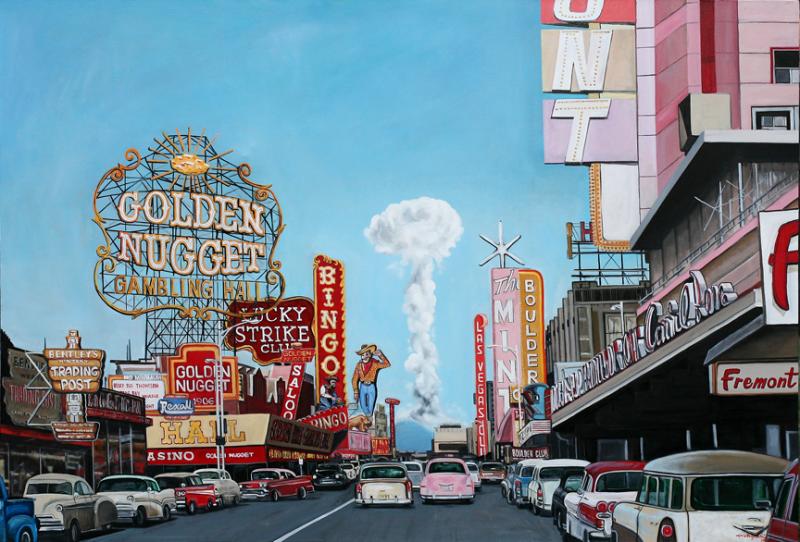
Notice the mushroom cloud in the distance.
We arrived at the outskirts of LasVegas in an hour or so. We were downtown at the corner of 5th and Fremont less than a minute later (try that today). We found a big old a hotel there, right across from a big (for those days) casino. $3 a night for a room, with shared necessities at the end of the hall. No need for a reservation.
We didn’t tarry long at the hotel. The four of us put on suits and ties (not particularly unusual in those days) and strolled across the street to the casino. Our plan was to work shifts as pairs, but we all wanted to see what was what at first. We walked in a side door and saw the Roulette tables right there. The place seemed empty, but this was a weekday afternoon.
Two of us sat at a table and started gambling. No doubt they knew we were neophytes, but we soon bought some chips and started working our system. One of us handled the chips and the other managed the string numbers. It was going well when a couple of other “gamblers” joined the table. It was obvious they (pit bosses?) showed up to see what we were up to, but there was never any negative feeling.
After an hour we decided to pause and ponder our observations and concerns. It had been a stress-filled 60 minutes. The Casino offered big steak dinners for a dollar so we sat down to eat. We were quite excited by the fact that we won $53. Remember, our estimate was that we’d clear $52 per hour. And there didn’t seem to be any trouble with what we were doing. We were ready for more.
We went back to the tables after dinner to gamble some more. Of course, we had begun to think this isn’t really a gamble. Things went well for a couple of hours and we decided to take our winnings and retire to our hotel. We wanted to be fresh for the next day, and we hoped the stress level would subside. We also decided not to split into shifts yet. After all, this was just a test, not a going operation.
At one point we ran into a string of losses. As I remember, we were down about $80. Our bankroll, including winnings, was about $500 by then. The next bet was $120 or so. We began to fear that there was a fatal flaw in our system. Remember, each string started with a 40 cent bet, with an objective to win 60 cents. No big deal. But risking $120 to win 60 cents seemed a little extreme. But we pushed the required number chips out to the Red square — and won.
We still had a long way to go before we were out of the hole. The size of the bets continued to decrease and we finally closed the string. We decided to take our winnings and go think about things for a while. Keep in mind, this was only one of many closed strings for the session. We cleared about $100 for the session even though we came close to ruining our bankroll on that one string.
We went back to the casino the next day for breakfast and more gambling. We did fine for a while, but then hit a bad spot. We came to a point where we needed to bet $180 or so. Of course, we had been losing a string of larger and larger bets so we ran out of cash. We decided to cash our remaining traveler’s checks. As we left the cashier’s window with our chips one of them said, “Those boys really are gamblers.” In retrospect, we were suckers of course. We were finally able to close out that string though.
You can guess what came next. In an hour or so we were ruined as they used to say. Our bankroll was gone. Now what? Well, we had a wealthy drinking buddy back in town. We gave him a call and explained our system and its temporary demise. We had figured out a way to reduce our initial bets from 40 cents to 25 cents (the minimum bet), so we could assure him we’d come out OK this time. He agreed to wire us the money the next day. Now, all we had to do was wait.
The next morning we went to the Western Union place to collect our cash. Yes, there was a telegram waiting. But it said, “SORRY. HAVE RECONSIDERED. DECIDED BEST FOR ALL NOT TO SEND MONEY.” We realized we were well and truly broke. We didn’t even have money between us to get back to McPherson. Oh, bother. Then Manley admitted he had secreted a $20 bill in his shoe. He figured this was going to happen.
Gas was about 20 cents a gallon back then. At 20 mpg, that’s one cent per mile. We had about 1,200 miles to go, so that was $12 for gas. OK, we could make it. We checked out of our hotel and headed out of town. We stopped at a gas station to fill up and spotted an offer of 5 quarts of reclaimed oil for a dollar. That old Chevy was an oil burner so we got the oil too. We also bought a loaf of bread and a jar of apple butter. Why not peanut butter? I don’t know.
We had an apprehensive feeling all the way back down Route 66. All we could do was push on and hope nothing went wrong. We arrived back in Kansas the next morning, with two or three hours of driving left to go. We had about $5 left so we knew we’d make it. We even splurged on a dozen donuts for breakfast.
Needless to say, our investors (speculators?) were devastated when we got back. And we still had to pay back their residuals. Oh well.
Too bad none of us knew anything about statistical analysis. We could have predicted exactly what would happen. Many years later, I learned that starting with $200,000 capital you could make $80,000 per year using our system. And the good news was you’d only go broke once (on the average) in 20 years. No wonder $300 only lasted 2 days.
*******
Note 1. A few people have been able to overcome the odds of Roulette. Claude Shannon, the father of information theory was one of them (and someone I’m connected to by 2 degrees in a Kevin-Bacon sense — see Note 2 next). [Claude Shannon, the Las Vegas Shark]
Note 2. My dad told me a friend of his knew the man who shot Billy the Kid. Well, I knew Barney Oliver who worked with Claude Shannon. Barney was the head of HP Labs when I worked there. He was a genius and a genuinely nice guy and he also knew all about information theory. [How Information Got Re-Invented]
Aerobatics took me on a path similar to those I traversed in learning to fly, sailing, and skiing. I began to lose my keenness for boring holes in the sky as I reached a certain level of confidence. Yes, it was nice to do loops, rolls, and Cuban eights once in a while, but solo aerobatics eventually lost it’s compulsion.
Sailboat racing had once made sailing fun for me again. Sailplanes had added renewed fun to flying. Aerobatics had been a life-long dream for me, so I was not surprised to feel my interest wane as it became easier. I could have gone into competition aerobatics, where the challenge is limitless, but that would have been expensive in terms of time, travel and money.
Steve Wolf entered an aerobatics competition event once himself. Sport Aviation had an article about it. Aerobatic figures and routines are rigid for this kind of competition. On the other hand, air show routines rely more on originality and fluid transitions. So it was no surprise to learn that Steve’s figures were not quite precise enough. That kept him from winning first place. The writer’s closing comment was, “But, the man can fly.” Yes, like few others.
Anyway, my intuition was I’d soon tire of the sustained hard work required to be competitive in aerobatics. I like to do unscripted things, not set routines for judges. Luckily, serendipity had already entered the picture when I met Dave Cook and learned how to roll his yellow Citabria.
Dave invited me to fly up to his hanger at the Sandpoint, Idaho airport. I began going up there for brunch on weekends and soon met two other Citabria owners he knew. One day we all made a short hop from Sandpoint over to Ohlmstead Sky Ranch where I was attacked by dandelions (scroll half way down that post). Group activity centered on a mutual interest is my favorite kind of social event. This was a perfect example.
Dave had rented an “office” at the end of the row of hangers where he kept his Citabria at Sandpoint. The idea of forming an aerobatics team came up during one of our “hanger flying” sessions there. The Blue Angles and similar aerobatic teams base their routines on formation flying. It adds a challenging and impressive dimension to aerobatics. Why not do it with our mismatched red, yellow, blue and green Citabrias?
High-performance airplanes are better suited to formation aerobatics than Citabria’s. We knew flying the kind of synchronized maneuvers that you see professionals doing would be foolhardy in our Citabrias. We could start off by learning to fly in formation, though, and maybe take it from there. Dave was the only one of us who had done formation flying so he gave us some ground schooling, and off we went.
The basic principles of formation flying are simple to describe: The leader of the formation is the eyes and ears for the whole “flight” (a group of airplanes). The other pilots match the leader’s maneuvers by keeping their eyes on the plane they are shadowing. They strive to hold a precise position with respect to its closest wingtip. That requires matching his attitude and speed precisely. They strive to maintain position in three dimensions with an accuracy of a few feet, and bank angle within a degree or three. Matching the leader’s speed within a few hundredths of a knot per hour is the hardest part.
It involves a little practice to get to where you can do all those things well. We got together at Sandpoint on most weekends the first summer to practice formation flying. We also began to devise aerobatic figures that emerged from close formation to separated paths and then rejoined in formation. That’s how we planned to avoid the risk of flying in a tight formation during an aerobatic figure. Yet the complete figure would be more interesting than any figure flown by a single plane.
FCC regulations for radio operations created a little problem for us right at the start. Communication with traffic controllers, for example, control towers is clear cut. The regulations for plane-to-plane communication are ambiguous, though. We decided it was best to ignore the question and plead confusion if we were accosted. Radio silence was just not an option while learning formation operations. No problem though. Who was going to hear us on an unused channel anyway?
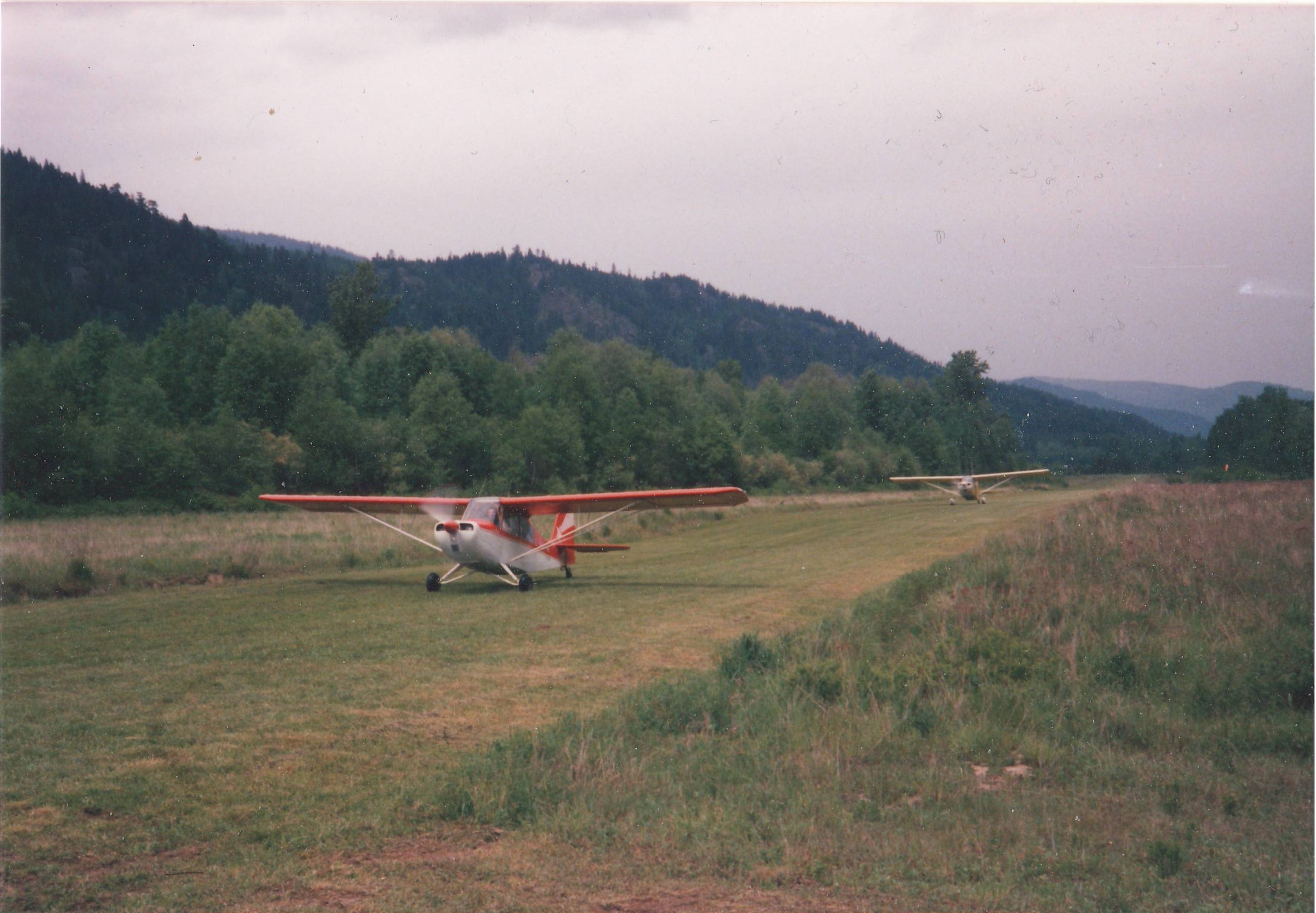
Off for an aerobatics session from the landing strip at Ohlmstead Sky Ranch.
The first aerobatic figure we developed is a good example of the ones we used in our routine. In this one, we transitioned from close formation to flying in trail (all the planes in line) by executing sequenced “U” turns.
It worked like this: The one on the left initiates a U turn. One second later, the next plane to the right follows. The third plane waits one second after that, etc. Since we are flying at 100 knots, we ended up all in line, separated by about 340 feet (the distance between goal posts on a football field).
If there are three planes, the second one then executes a barrel roll while the third one executes a loop. The planes end up separated by about 1000 feet because a barrel roll takes more time than level flight and a loop takes more time than a roll. Now all three can safely execute loops or Cuban eights in unison. To rejoin the formation and begin the next figure they fly a reversed form of the U-turn maneuver. (Those U turn maneuvers are easier to fly than to think about.)
We eventually had three or four similar figures in our routine. Coupled with our formation flying and some individual figures we had a nice little air show. Then we put on a couple of private routines for friends and families. We continued to polish our routine for a couple of years but some team members began to miss sessions. I decided to drop out when that happened. It was obvious that our sporadic practice created a safety hazard.
Then we put on a couple of private routines for friends and families. We continued to polish our routine for a couple of years with an eye to public performance. But some team members began to miss sessions. I decided to drop out after that. It was obvious our sporadic practice created a safety hazard.
One of the last things that we did as a team was fly to a big airshow at Glacier Park National Airport near Kalispell, Montana. We flew in “loose formation” over there and back. When you arrive the team leader calls the tower to request landing clearance as a “flight of four.” Then we executed a snappy military-style roll out to position ourselves for closely sequenced landings.
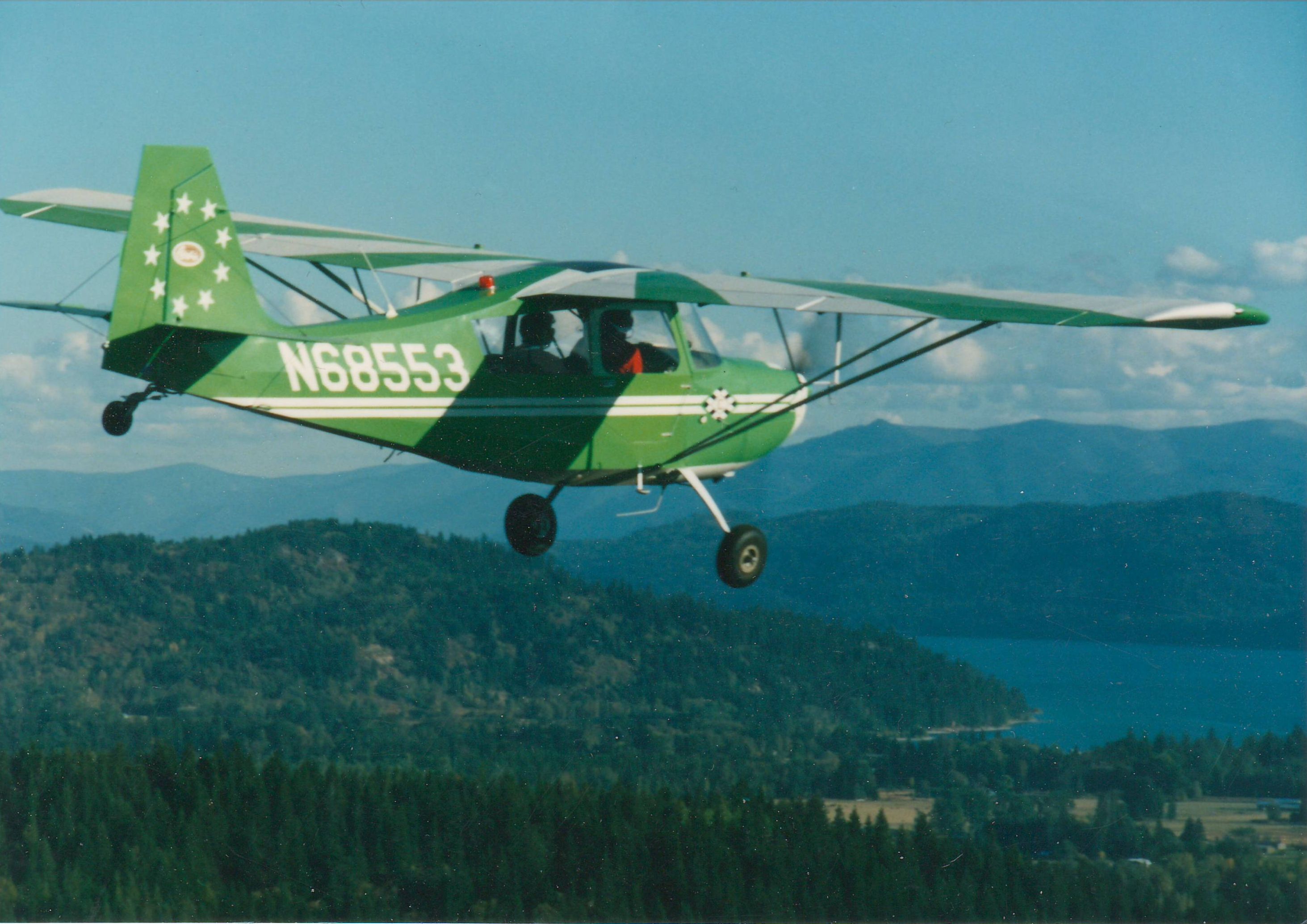
Marcia and I over Pend O’Reille Lake on our way to the airshow. There were four planes on the flight.
Marcia did quite well on the flight over but it was too hot when we got to Kalispell. She ended up dehydrated and we had no luck getting water for her. Eventually, we had to walk quite a ways to the terminal building, and that added to her distress. We needed to refuel when the show was over, but there was a big wait for the fuel truck. We hopped over to a little airport nearby and got our fuel. By then it was a little cooler, and we had a nice flight back over the mountains.
 Didit.Live